Prof. M. L. T. Kannangara Gold Medalist Interview Responses: Name: Ms. Shehara De Silva YEAR: 2025
- Could you tell us a little about your background?
- Where did you grow up, and what was your childhood like?
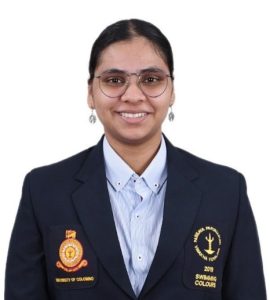 Answer: I grew up as an only child in a multi-religious family in Ratmalana of the Western Province of Sri Lanka. Throughout my life, I’ve had a variety of experiences, not limited to science, such as learning drama and acting for more than a decade, swimming for almost two decades, and learning multiple languages at different periods. I spent my childhood curious about everything! This was a trait that followed me throughout my life. Not having an ‘only science’ background definitely helped me become who I am today.
- What first sparked your interest in science?
- Was there a particular experience, person, or event that inspired your curiosity about science?
Answer: A lot of people can pinpoint an impactful occurrence in their childhood or adolescence that sparked their immediate interest in science. In my case, however, it was very much a gradual process. This doesn’t mean that I wasn’t interested in science as a child. I was. However, I was engaged in a variety of activities and hobbies, so science was only one of several interests. While I enjoyed watching the stars and asking my parents about extraterrestrials and dinosaurs, I didn’t immediately know that science would be what I pursued in life.
- Why did you choose to study Physics?
- What motivated you to pursue an Honours Degree in Physics at the UOC?
Answer: When I came to the University of Colombo to do my undergraduate studies, I had not decided on the subject I would be pursuing my Honours Degree in. The possible options for me were either Physics or Mathematics. I followed quite a scientific method in figuring out which field and subfield I was the most interested in. The method was to give every subfield in both Physics and Mathematics the chance to impress me and win my devoted interest! By the end of the 2nd year of my BSc, Physics had won the contest over Mathematics. By the 4th year of my BSc, Particle Physics had won the contest over the subfields in Physics, with Cosmology taking second place.
- What does receiving the Prof. M. T. L. Kannangara Gold Medal mean to you?
- Have you heard of Prof. Kannangara before learning about this award? What have you learned about his contributions, and how do they resonate with you?
Answer: While I have, of course, heard about Prof. M. L. T. Kannangara before, I hadn’t heard of the award before. It feels unreal when I realise that I am receiving an award named after this esteemed individual! I am deeply honoured to receive this award and hope that I do justice to this honour!
- Are you considering graduate studies in the future?
- If so, what field or research area interests you most, and why?
Answer: As I write these words, I am actually in Cincinnati, pursuing my recently commenced PhD in Physics at the University of Cincinnati, Ohio, USA. I made the decision to begin my graduate studies in Fall 2026, right after completing my Bachelor’s degree in Physics. The particular area I am interested in is Particle Physics, but I am currently undecided about whether it’s going to be theoretical, experimental, or phenomenological Particle Physics.
- What are your long-term career aspirations?
- Where do you see yourself in the next 5–10 years, and what impact would you like to make through your work?
Answer: 5-10 years from now, I see myself perhaps working in research or academics in the field of Physics. I recently had my first recitation/tutorial session as a TA at the Department of Physics, and I absolutely loved it! It appears that I enjoy teaching! Something I hope I will be able to impart to the world is that Physics is fun. Just like anything else, it requires hard work, but once you look deeper into the subject and really try to appreciate it, it becomes so much more meaningful and special. This is something I feel strongly about, because I feel that not many students give Physics the chance to impress and entertain them. I just want to show everyone how to enjoy Physics.
- Reflecting on your experience, what made your Special Degree journey rewarding, ?
-
- What would you say to encourage a student who is unsure whether to pursue an Honours Degree?
Answer: If science and mathematics interests you, then I think it is better to consider pursuing an Honours degree. Even if you aren’t sure if you want your future career to be related to science, having an Honours Degree qualification is a worthy accomplishment that will boost your resume. If you are currently interested in a career in science/mathematics but are not sure if these interests will remain several years later, then too, I think it is better to pursue an Honours Degree. In case your interests change later, there will be no harm done since science education only improves your experience and knowledge. And if your interests remain, then you have taken a very good decision in pursuing it. The best part is that you can diverge into many other fields (like Banking, Finance, etc.) after completing the Honours Degree.
- Do you have any specific advice for current or prospective Physics students?
- What habits, skills, or experiences do you believe contribute most to success in Physics?
Answer: What helped me the most during my undergraduate years was that I made sure that I liked what I did, and that I liked the person I was while doing what I did. I also looked forward to the person I would become after completing my Bachelors’ degree. This doesn’t mean that I enjoyed every single course that I took during those 4 years. That’s not realistic! However, I always put effort into seeing things from a better perspective and trying to like it, even if I originally did not. But what do you do if you just aren’t interested in a particular course or subfield in your chosen field? Let me tell you the method I followed. The subfields in Physics that I am interested in are Particle and Nuclear Physics, Astrophysics, Cosmology, and Biophysics. The rest of the subfields just are not my top pick! However, I still had to take many academic courses and laboratory courses related to subfields that I had lesser interest in.
The method I followed was to pretend that this particular course was my favourite of all and that I really loved studying it. This pretending would continue for a good 2-3 weeks before I actually start developing an interest in it and start enjoying studying it. I remember a course in my final year that had nothing to do with my chosen future field. I successfully managed to convince myself that I loved the course and I honestly had fun doing problems for the course’s reference textbook.
Another good method is to pretend that you are teaching the course to a class of students. This method is highly recommended!
- What extracurricular activities were you involved in during your university years?
- How did these activities contribute to your personal growth and development?
- Which activity or experience was most meaningful to you, and why?
Answer: I was a member of the Gavel Club of the University of Colombo since 1st year and was a member of the Editorial Subcommittee for two consecutive terms. Through the Gavel Club, I took part in several Gavel Competitions, both organized by UOC and other Sri Lankan Educational Institutions like University of Kelaniya. This led me to gain much experience and receive a few awards along the way! Besides, this made my public speaking skills improve immensely, which benefitted me during research presentations and thesis presentations as well.
I was a member of the Physics Society of the University of Colombo during my undergraduate years and was appointed the Secretary of the society for the term 2024/2025. I had a lot of fun helping organize many Physics Talks Sessions, Guest Lectures, and other events.
I was part of the Swimming Team of the University of Colombo during my 3rd year at university. It was very nostalgic for me since I had been a swimmer during the entirety of my school years and brought back the feeling of being at a Swimming Meet, competing for victory and honour! While it was difficult managing time with both studies and training, engaging in swimming actually helped me concentrate better at studies. So, I would definitely recommend engaging in a sport during the undergraduate years.
I also wrote articles, poems, and short stories for the FOS Media Blog during the first few years of the BSc Degree. It gave me the opportunity to express myself freely and talk about things that I felt were important in Society, like saving the environment and appreciating our parents, amongst others.
I was also a part of the Astronomical Society of the University of Colombo and was a writer for the Sigma Magazine during the 2023 and 2024 issues and was a Joint Editor in Chief during the 2025 issue of the magazine.
It is a little difficult choosing one activity that was most meaningful to me. What I can say is that all these activities that I took part in were integral in molding me into the person I am today. The journey was dynamic and the growth spanned the entire 4 years that I spent at the University of Colombo. I am very grateful for the opportunity to take part in all of these activities and gain the experience that I did.
- Is there anything else you would like to share with the CUFSAA community or the wider STEM student population at the UOC. (Any advice, insights, or words of encouragement for future generations of students?
Answer: I wish everyone the very best in their education, career and lives. I hope you are able to do everything you wish and hope to. And I hope you become the person you hope to be during this life. The world is not an easy place to survive in. Dreams are not often easily achieved. However, anything is possible with dedication, effort, and a good plan.
I will leave you with a motto that I live my life by. I mention it thrice, because of how important it has been in my life:
Impossibility Is Relative.
IMPOSSIBILITY IS RELATIVE!
Thank you.
Shehara De Silva